For many developers, AI coding assistants are already as fundamental as a terminal window or version control system. Data from DORA shows that 90% of IT professionals are using AI at work. StackOverflow’s 2025 Developer Survey found that over half of professional developers use AI daily.
But pushing more code faster is only a win if that code is reliable. AI coding assistants can make helpful suggestions and changes, but humans still need to validate and potentially fix the new code. This is probably why the StackOverflow survey found trust in AI is not keeping pace with adoption. The top complaint is "almost right, but not quite" answers, with 45% of developers saying that debugging AI-generated code can be more time-consuming than writing it from scratch.
Devs don’t just need helpful suggestions: they need AI that can safely and reliably do the work inside the systems where code is built and shipped. This is the shift from AI assistants to AI agents. And in this blog post, we explore where this shift is having the most impact: your CI/CD pipeline.
Why CI is the right place for AI agents
AI agents can operate independently toward an objective, often taking actions through APIs and integrations to get a job done. It’s early, but the trend is clear: Gartner projects that 33% of enterprise apps will include agentic AI by 2028, a huge jump from less than 1% today.
DevOps is the natural ground zero for this shift. As IBM notes, AI is perfectly suited to augment CI/CD by automating monitoring and scaling, predicting failures and recommending pipeline optimizations. By bringing agentic AI into the pipeline, we go beyond asking for a fix; we’re asking the agent to propose the fix, test it, show us that it works, and then implement. By coupling AI actions with the continuous, system-level validation that can only happen inside CI, you cut through several layers of friction and deliver real time-and-focus saving to busy teams.
New Bitrise AI features solving for real friction 📣
We’ve built five AI features that address specific, time-consuming friction points in the mobile development lifecycle. These features mostly assist, but are also starting to bridge the gap to full autonomy.
1. AI Build Summary
Finding the root cause of a failed build can involve manually digging through 1,000+ lines of log. Now, if your Bitrise build fails, an AI-generated summary appears right on the build page, giving you a concise reason for the failure and suggesting a fix. This feature is free and unlimited, and helps you get your build back to green faster.
2. AI Code Reviewer
Code reviews are essential for quality, but can become a bottleneck, especially when reviewers lack context. Our new AI Code Reviewer automatically posts a high-level summary on every PR in GitHub, walking through the change logic and highlighting potential issues. According to independent research from McKinsey, this “instant first pass” can speed up your code review process by 7x, saving human reviewers valuable time and acting as your first quality gate.
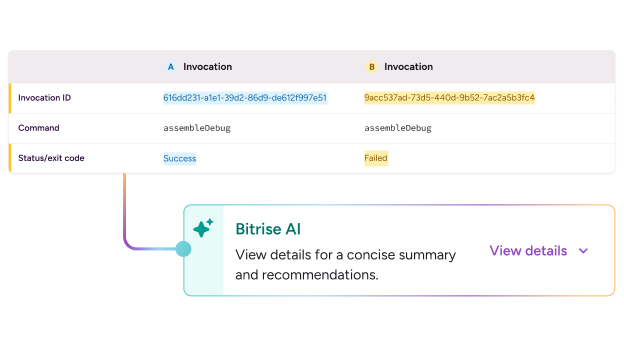
3. AI Invocation Summaries for Build Cache
Optimizing your Bitrise Build Cache can involve parsing dense comparison screens to spot the meaningful differences between invocation logs. Now, AI Invocation Summaries highlight key differences and recommend optimizations, saving significant toil and time. This feature is included and unlimited for all Build Cache customers.
4. Bitrise MCP
Switching between your IDE and your CI platform to check on your build is business-as-usual, but the StackOverflow data shows that IDE integrations are the most dominant use of AI among developers. (And also, we don’t need data to know that anything that minimizes context-switching is welcome.) The Bitrise Model Context Protocol (MCP) server keeps you in your IDE and lets you talk to Bitrise from AI clients like VS Code, Claude, and Cursor. Ask questions about builds, get suggestions for optimizing your workflows, and automate tasks, all without leaving your development environment.
5. AI Build Fixer
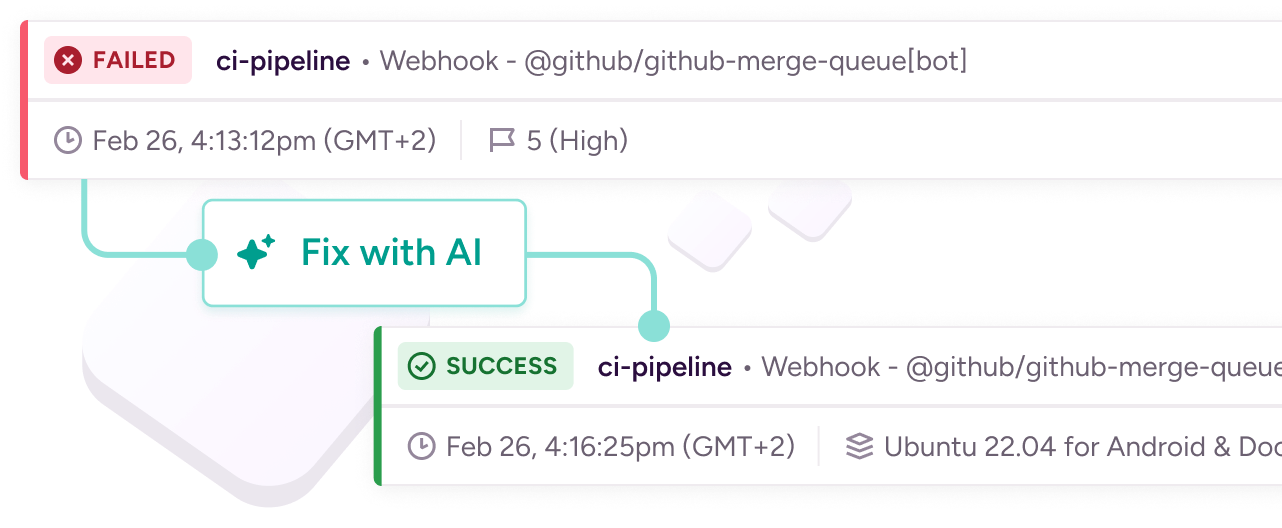
Build Fixer is our first true AI agent, where AI moves from helpful to truly productive. It goes beyond finding the cause of a failed build and suggesting fixes: it analyses the failure, opens a PR with the necessary code changes, and autonomously triggers a new build to validate the fix.
This is a powerful feature, and since we know trust in AI tools is still mixed, we’ve also kept our approach aligned with best practices:
- It keeps a human in the loop. The PR-first model doesn’t merge anything to main. A human still has to approve, but it save them from having to implement the fix.
- It ensures simple rollback by using your existing version control system as a safety net; no additional configuration or processes required.
- It cuts recovery time. Agentic workflows are well suited to context gathering and root cause analysis. AI Build Fixer applies this logic to failed build recovery, replacing a multi-step manual process with a single click.
- It takes validated action. The system doesn't just propose a fix; it autonomously validates the fix by running a build, closing the feedback loop instantly.
All these features are available on Bitrise Pro and Enterprise plans.
The path from assist to act
The journey to agentic AI will happen in stages: trust has to be earned and developers are not ready to hand over the keys to autonomous systems just yet. According to the StackOverflow report, almost 70% of devs say they never use any kind of agentic AI. Realistically, we think widespread adoption will have three main stages:
- AI assists where you already work: summaries, first-pass reviews, and suggestions to speed up human decision-making (established).
- AI acts with human approval: small, reversible changes in a format that humans can easily review, like a PR (emerging).
- AI acts independently: on well-defined, low-risk, and repetitive tasks, the system can act on its own with confidence (future).
The DORA research confirms that working in small batches and relying on version control safety nets are critical for high performance. An AI that opens a PR with a small change is working within this proven model, not against it. By starting with assistance, moving toward approved actions, and finally true autonomy, mobile teams can cut down on manual work and accelerate release cycles without adding risk.
Practical adoption starts with best practices
According to the DORA report, AI magnifies both the strengths and weaknesses of the system it operates in. Results depend less on the specific AI tool and more on the engineering practices and platforms that surround it. The teams who see the best results from AI tools build a strong operating model around the technology, based on the same fundamentals that define high-performing engineering teams.
You can start building Bitrise AI into your practices and processes today, following the same principles of gradual adoption.
- Start with assistance. Experiment with the free features first: AI Build Summary (and AI Build Cache Invocation Summaries, if you are using Build Cache). These assistants deliver instant value without changing your workflow.
- Accelerate human review. Enable AI Code Reviewer on a few key repositories. Use it as a first-pass check to speed up reviews, not replace them.
- Move to approved action. Try AI Build Fixer on projects where the PR-first model is a good fit. See how much time your team saves by automating fixes.
- Integrate your workflow. For power users who want to dig deeper, connect Bitrise MCP to your IDE to bring CI management directly into your development environment.
This approach lets your team build trust in the system, and adopt agentic AI at their own pace and as they find value in it.
The future is agentic
The next big wave of accelerated developer productivity will be powered by agentic AI. The time to prepare is now.
At Bitrise, we are pushing the boundary by bringing intelligent action directly into the mobile CI/CD pipeline, where autonomous AI fixes can be validated by the system itself. Today, Bitrise is one the first CI/CD platforms that can automatically fix failed builds without any third-party add-ons. Tomorrow, AI agents will be everywhere. But until then, why not give it a go?
Ready to see how it works? Try Bitrise today.
Have more questions? Check out our AI FAQ.
Get started for free
Get a 30-day free trial and join the 400,000+ mobile developers who already love Bitrise.
Start free trial