What is continuous delivery?
Continuous delivery is a software development practice focussing on automating the delivery of code updates to production both quickly and reliably.
What is continuous delivery?
Continuous delivery (CD) is a software development approach focused on ensuring that your software is always production-ready, enabling developers to eliminate bottlenecks, streamline release cycles and ensure software reaches end-users quickly and reliably.
Key characteristics of continuous delivery:
- Deployable at any time: The software is designed to be deployable at any point in its development lifecycle.
- Prioritization of readiness: The development team prioritizes maintaining the software's deployability and production readiness over starting work on new features.
- Fast, automated feedback: Changes are tested automatically and trigger immediate, automated feedback on production readiness.
- On-demand deployments: Any version of the software can be deployed to any environment through a simple, automated, "push-button" process.
Continuous delivery explained
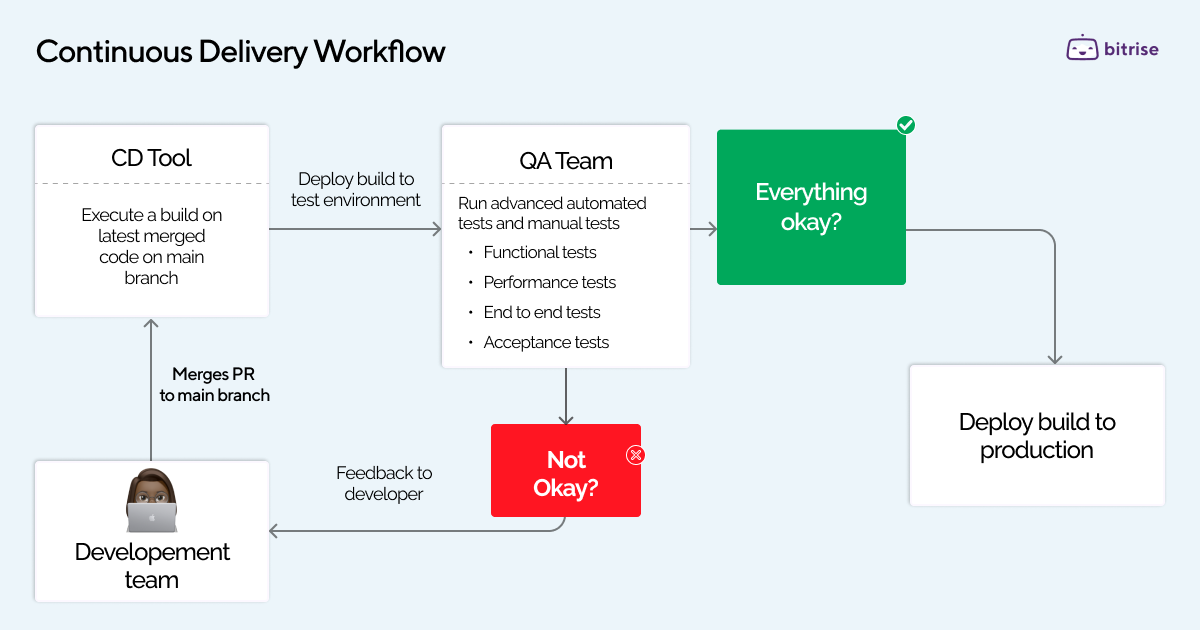
After code is merged into the central branch (main, master, etc.), continuous delivery takes over. It automates the delivery of CI-approved builds into production-like environments (e.g., staging), for final testing and review before being released to the live production environment.
Tests such as performance, security, acceptance, and smoke tests that require a full delivery environment are often integrated into the CD pipeline and executed after builds are delivered to target production-like environments.
By delivering working code to production-like environments for further testing and review, CD reduces deployment risk and increases confidence that the application will work in production.
A CD process will generally:
- Pull the latest code from a specified version control branch and execute a build. Some may release/push to staging as soon as a PR is merged, while others may follow a set schedule (e.g., 10 a.m. every Monday).
- Configure the code with the right environment variables for the target production-like environment (staging, testing) and then deploy it.
- Run further automated tests (UI tests, end-to-end tests, performance tests). Most teams make provisions at this stage for QA engineers to carry out some manual verification tests.
- Depending on the setup, run a final build and test pipeline on the main branch, then either create an artifact that can then be deployed to production at the click of a button or ‘promote’ the build from staging to production.
Continuous delivery vs continuous deployment
Continuous integration focuses on integrating code changes and preserving code quality through automated builds and tests. Continuous delivery extends this by automating the release process so changes reach users faster.
Continuous delivery and continuous deployment are often used interchangeably. But the key difference is how much the release process is automated. In continuous delivery, code changes are deployed to a staging environment but require manual approval before going live. In continuous deployment, code changes are deployed straight into production with no manual intervention.
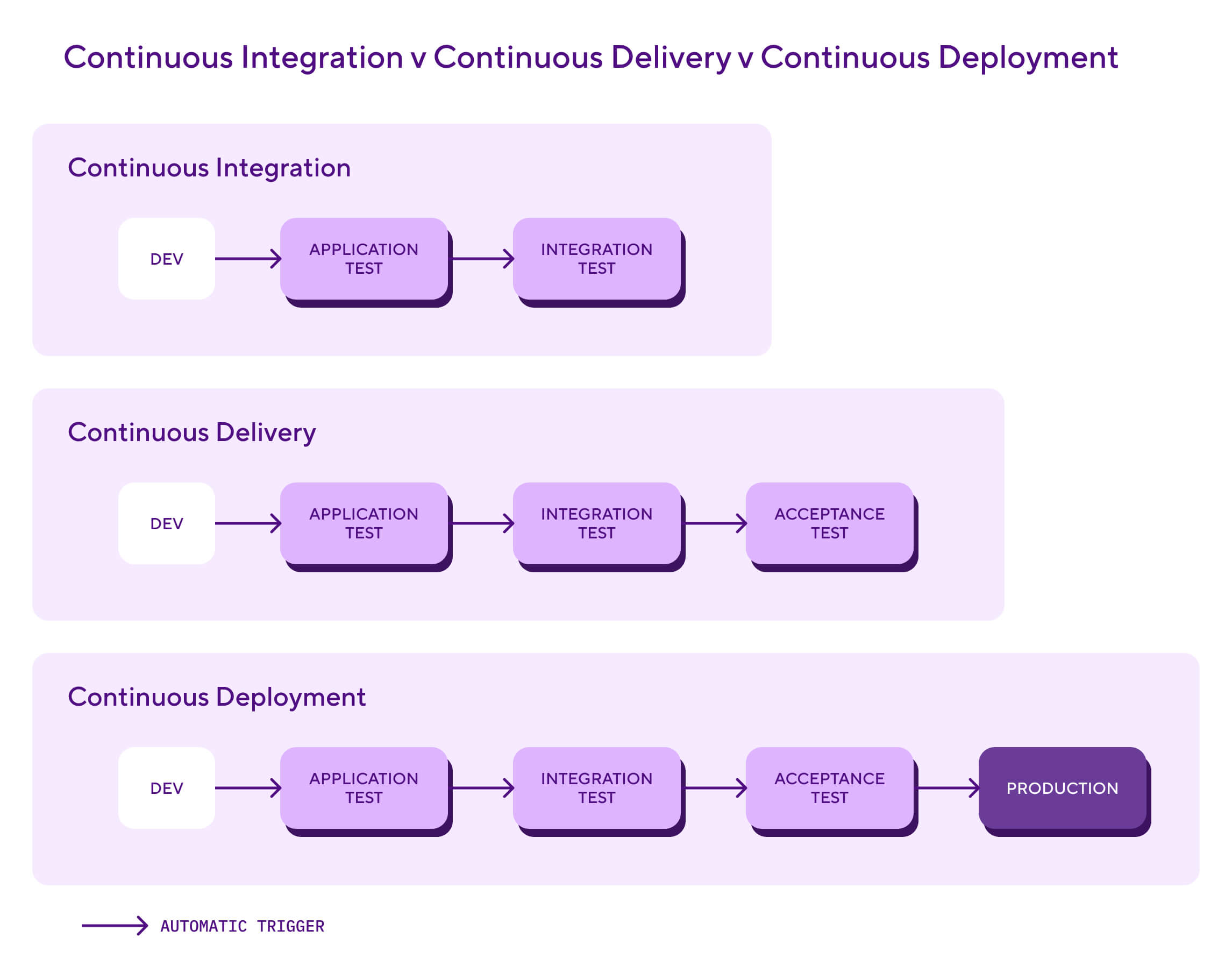
The choice between continuous delivery and continuous deployment comes down to your organization’s risk tolerance, business objectives, and technical capabilities:
- Organizations subject to strict oversight and compliance requirements may lean toward continuous delivery because it allows for more controlled and auditable releases.
- Organizations that prioritize rapid feature delivery and accept slightly higher risk for faster time to market may opt for continuous deployment.
Teams that want to combine the speed and agility of continuous deployment with the additional control inherent in continuous delivery have a third option: progressive delivery. In progressive delivery, changes are automatically deployed into production but are hidden behind feature flags and gradually rolled out to a subset of users. This provides granular control over releases and gives teams the opportunity to gather real-world user insights and performance data before a full release.
Continuous delivery v continuous testing
Continuous testing is the practice of testing software as part of the development process, instead of waiting until the end of the development cycle. By integrating testing into the delivery pipeline, developers gain real-time feedback on the quality of their code. This approach is essential for speeding up development and deployment and is a cornerstone for enabling Continuous integration (CI), continuous delivery (CD), and continuous deployment (CD).
There are a number of ways to perform continuous testing such as:
- Automated testing: Automated testing uses software to perform tests without the need for manual intervention. This can be especially useful for running large numbers of tests quickly and consistently.
- Cloud-based testing: Cloud-based testing allows you to run tests on a wide variety of devices and operating systems without the need to physically own or maintain the devices. This can help you ensure that your software works correctly on a variety of different devices.
- Continuous integration: CI involves automatically building and testing code changes as they are made, rather than waiting for a large batch to be tested. This helps catch issues early on in the development process.
By implementing these practices, you can help ensure that your software is of high quality and performs well on a variety of different devices and operating systems.
What are the benefits of continuous delivery
The benefits of continuous delivery are numberous. A strong continuous delivery framework is essential for keeping pace with innovation, as traditional software releases are often stressful and fraught with risk poorly managed.
What are the best practices of continuous delivery
Continuous delivery/deployment feels like it deserves its own deep dive into best practices because CI often steals most of the headlines. Here are some essential CD best practices to get you started:
Strategic foundation
- Start where you are: Don't delay implementation waiting for a perfect platform. Focus on identifying bottlenecks in your current deployment pipeline and automate the most cumbersome manual steps first.
- Decouple deployment and releases: Utilize feature flags to deploy code to production without immediately activating new features for users. This will ensure safer testing directly in the live environment.
Risk mitigation and quality
- Embrace progressive delivery: Implement techniques like blue-green deployments, canary releases, or feature flags to manage risk, and enable smooth rollbacks and safer product iterations.
- Automate deployment validation: Immediately follow releases with automated smoke tests and health checks. Any failed validation should be configured to trigger an automatic rollback.
- Maintain environment consistency (Parity): Ensure development, staging, and production environments are as consistent as possible. Use Infrastructure as Code (IaC) tools to prevent configuration drift between these environments.
Operational excellence
- Practice zero-downtime deployments: Design your application and deployment process to allow updates without interrupting service. This can involve using techniques such as rolling updates or load balancer switches.
- Simplify and test rollbacks: Ensure a quick return to the previous stable version is always possible. Test your rollback mechanism regularly, aiming for a one-click operation wherever feasible.
- Implement comprehensive monitoring: Monitor both critical technical metrics (like error rates and response times) and key business performance indicators (such as user conversion rates and engagement) to swiftly detect and address issues.
What are the challenges and solutions of continuous delivery?
Continuous delivery and continuous deployment offer significant advantages by accelerating and streamlining software updates. Teams benefit from the ability to release updates more frequently and adapt quickly to market demands. However, this increased velocity introduces a distinct set of challenges, including new threats teams must be prepared to identify and address.
Continuous delivery with Bitrise
Bitrise CI enables continuous delivery and continuous deployment for mobile teams by automating the entire journey from successful build to app store submission. While traditional CI platforms stop at "green builds", Bitrise extends delivery automation to handle the unique complexities of mobile releases: managing iOS certificates and Android keystores, coordinating phased rollouts across multiple store fronts, and orchestrating releases for both platforms simultaneously.
With intelligent build triggers and merge queue support, only production-ready code progresses through your pipeline. Automated code signing ensures expired certificates never delay releases, while integrated Release Management provides a unified dashboard to monitor app store submissions, manage staged rollouts, and coordinate cross-platform releases. Test results, flaky test detection, and AI-powered build summaries surface quality signals directly in pull requests, so teams can confidently merge and deploy without manual verification bottlenecks.
Most teams who try Bitrise get their first mobile build up-and-running in minutes, not days. The result: faster builds, zero CI maintenance, and more confident releases without the need for dedicated DevOps expertise.
See what Bitrise can do for you
Confidently build, test, and ship high-quality mobile apps with Bitrise.