Bitrise Build Hub is a vertically integrated mobile CI/CD infrastructure layer that drops into GitHub Actions with one line of YAML. GitHub Actions runs your CI, but its Mac runners are holding your mobile builds back. Limited M1/M2 hardware, stale Xcode, no cache co-location, no macOS uptime SLA. The infrastructure wasn't built for mobile. Build Hub was.
Build Hub upgrades the runner layer underneath. M4 Pro Apple Silicon with 54 GB unified memory, 99.9% uptime SLA, auto-scaling with immediate availability, Xcode updates within 24 hours of Apple's release, ephemeral VMs from clean snapshots, co-located cache with 100GB KV storage, and automated release management.
We own the hardware, designed the rack chassis, and manage every data center. That vertical integration is what makes the reliability, speed, and Xcode freshness possible. Whether your builds come from human developers or AI coding agents, the infrastructure is ready. One line of YAML: runs-on: bitrise-m4-pro. Everything else in your GitHub Actions setup stays exactly where it is.
TL;DR
- M4 Pro machines with 54 GB RAM = 54% faster than GitHub-hosted runners
- Xcode updates within 24 hours of Apple release
- Ephemeral VMs from clean snapshots
- Immediate availability with auto-scaling architecture
- Co-located Build Cache in the same rack as your runners
- Enterprise-grade security with guaranteed 99.9% uptime, publicly tracked
- Free self-serve trial available now, no migration, no workflow changes
The fastest Apple Silicon fleet in the cloud for mobile CI/CD
Bitrise Build Hub gives you the latest Apple M4 Pro Mac Mini with 14 vCPU (10 performance cores) and 54 GB unified memory. These aren't off-the-shelf machines. We stack 32 M4 Pro Mac Minis per custom-built 6U rack chassis we call the "Mini Orchard," wired with 10 Gigabit Ethernet, 4 TB NVMe SSD, and dual-plenum cooling engineered for zero CPU throttling. We own the hardware and the chassis design, and manage every data center. The battle-tested virtualization that serves millions of customer builds every month offers proven reliability.
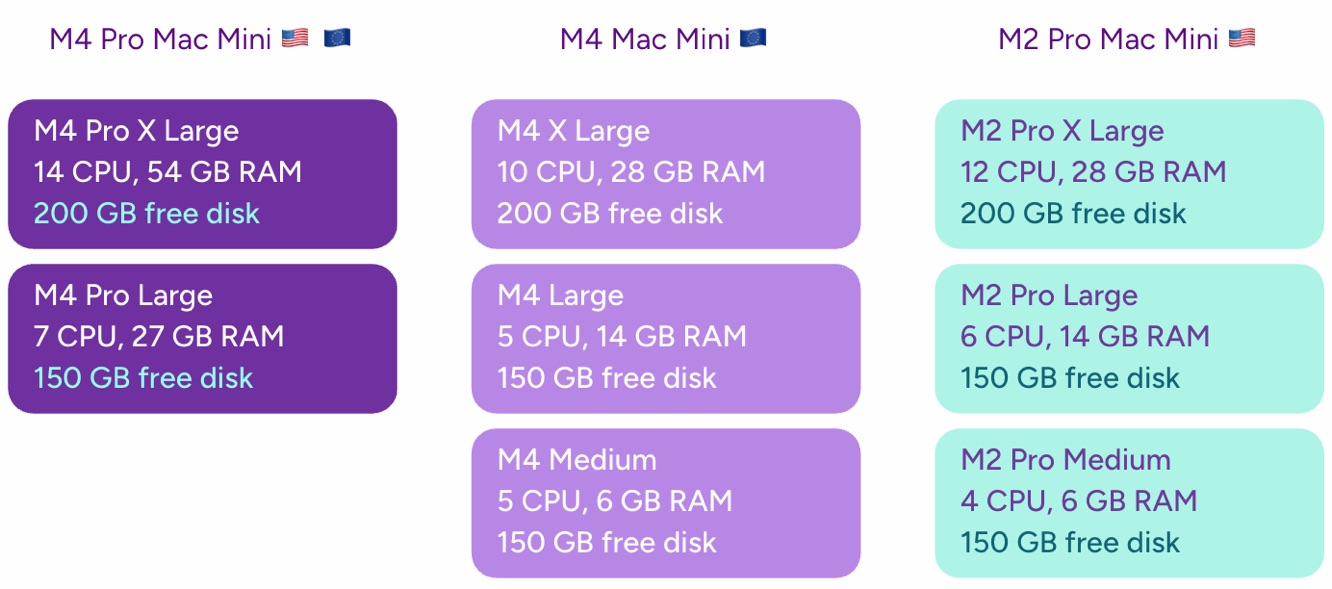
Mobile teams need the right size machines, not just the biggest. Build Hub offers the widest mobile CI/CD tailored Apple Silicon portfolio on the market: M4 Pro X-Large (14 vCPU, 54 GB) down to M4 Large (5 vCPU, 14 GB), plus M2 Pro options. Full specs are in the fleet documentation.
Auto-scaling Mac
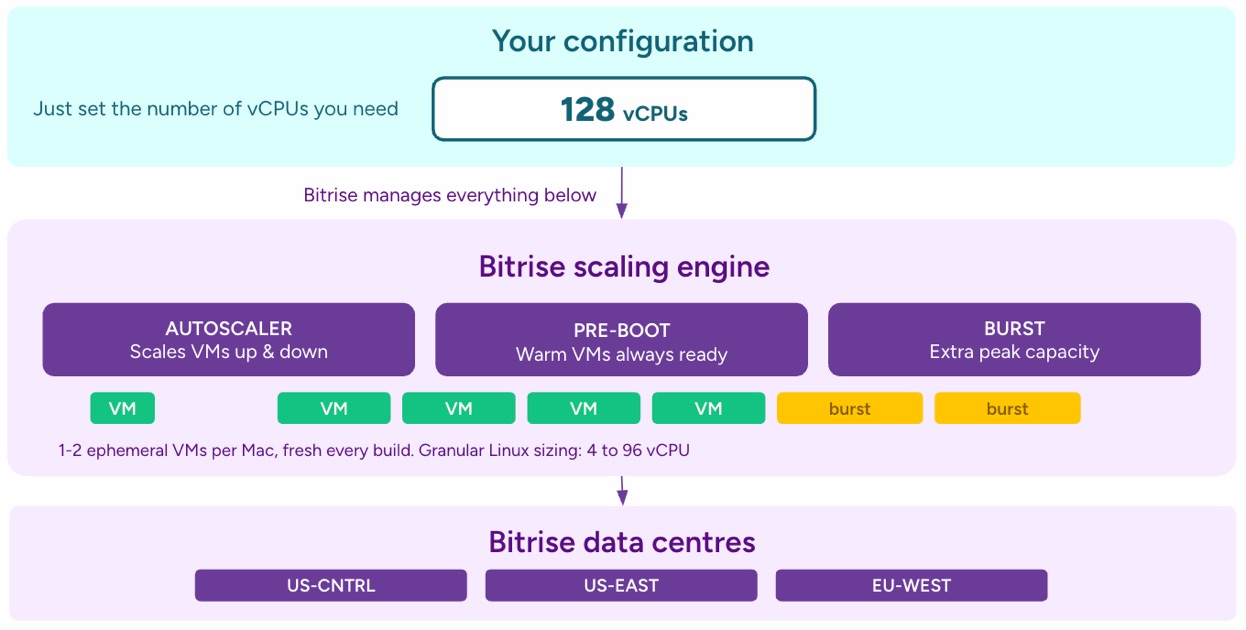

GitHub caps concurrent macOS jobs at 5 (standard) or 50 (Enterprise), with no burst option. AWS EC2 Mac requires a 24-hour minimum host commitment per machine. Bitrise Build Hub prewarms VMs ahead of Github Actions job execution, scales automatically by vCPU count, and handles peak load without over-provisioning.
54% faster on Mac: XcodeBenchmark results
Compiled using XcodeBenchmark with Xcode 26.3
Foreflight’s app (Objective-C, Swift and C++ codebase) is over 2M lines of code. On GitHub's runners, memory pressure caused builds to fail in ways that were hard to reproduce. With Build Hub's 54 GB RAM, those failures disappeared.
It's not just CPU clock speed. Unified memory architecture on Apple Silicon means CPU and GPU share a single pool with no copying overhead. For Xcode compilation, which saturates both compute and memory bandwidth, this matters next to raw core count. That's the reason we specced our macOS fleet this way, and it's the kind of thing the generic GitHub Actions runner alternative market isn't set up to care about.
Test our speeds for yourself with our no-strings free trial:
31% faster on Android with fewer cores
Compiled using Thunderbird Android, Gradle assemble
A 14-core machine just outperformed a 16-core one on an Android build. Not just because of faster clock speeds, but because we offer the ideal number of cores for the actual Gradle dependency graph to avoid performance degradation due to administrative overhead. A well-configured machine with fewer cores but better memory architecture will outperform a bigger machine every time.
For the best cost-to-performance ratio, Bitrise is the only provider offering non-standard, granular Linux machine sizing: 4, 6, 8, 14, 16, 24, 32, and 48 vCPU on AMD EPYC Zen5/Zen4 servers, up to 192 vCPU for teams that genuinely need it. Usage-based vCPU pricing means your Android builds on 6 vCPU don't pay for 8.
Full Linux fleet specs in our downloadable datasheet and the build machine types docs.
99.9% uptime on Bitrise infrastructure
Faster hardware only matters if your builds actually run. The teams we talk to most often don't open with "we need faster builds." They open with "we need builds we can rely on." When CI is unreliable, the damage goes beyond the failed job.
Build Hub runs on infrastructure Bitrise manages and operates in US and EU data centers, on purpose-built hardware with rolling updates, blue-green deployments, and immediate availability, guaranteed. Current and historical status is public at status.bitrise.io.
ForeFlight’s experiment
ForeFlight tried running lighter iOS jobs on GitHub-hosted runners while Build Hub handled the heavier jobs. At production volume, with a 2M+ line codebase, they immediately hit memory-related crashes and inconsistent performance on the lighter jobs. They shut the experiment down after one week. Before choosing Build Hub, they'd evaluated AWS, MacStadium, DIY infrastructure, and other CI providers. Build Hub won on reliability and pricing.
Nathan Hillyer, Director of Engineering at ForeFlight:
"We'd gotten used to the reliability with Bitrise and its 54 GB of RAM. Once you have that, it's very hard to go back. CI isn't just a convenience or a quality check. It's critical to how we ship."
Nathan walks through the full story, including why they shut down GitHub runners and what they evaluated, in this webinar.
Zero environment drift with ephemeral VMs
Environment drift is the slow accumulation of state on long-running VMs: dependencies vanish, gem versions shift, simulators behave differently between runs. These failures don't reproduce locally and take hours to diagnose.
With self-hosted bare metal runners, ForeFlight's team lived with environment drift. "You prayed that your job didn't hit the old M1 agent." Nathan recalled. One bad job could corrupt the shared state. Every workflow needed DevOps review. Developers couldn't write their own CI jobs independently.
Build Hub runs every build on a freshly provisioned ephemeral VM from a clean snapshot. Same OS, same tools, same build environment, every time. Destroyed after the build, recreated for the next. No wait times for your GitHub Actions jobs.
With infrastructure offloaded, ForeFlight's DevOps team stopped spending time on OS patching, Xcode image management, and hardware lifecycle. They focused on workflows, developer productivity, and system design instead. "We can pretty much open up the floodgates for people to write what they want without us having to oversee everything."
Pre-configured build environments include iOS simulators, Android emulators, fastlane, CocoaPods, and SwiftLint. Full details at bitrise.io/stacks.
Xcode updates within 24 hours
When Apple releases a new Xcode, GitHub's runners take weeks to update. Sometimes months. Your team can't test against the new SDK, access new APIs, or catch breaking changes before production.
Most teams don't fully adopt a new Xcode version for 19 to 21 weeks. Apple spotlights apps using the newest OS features. Xcode adoption speed directly links to App Store competitiveness.
Build Hub delivers new Xcode versions, validated and deployed, within 24 hours of Apple's release, beta and GA. The full update: Xcode, iOS simulators, and mobile toolchain. Not just the binary. We delivered Xcode 26.3 within 24 hours. This is our standard process.
Nathan at ForeFlight:
"It moved the infrastructure to something purpose-built for mobile and did all those hard things like Xcode updates within 24 hours that we struggled with."
Pin production builds to stable Xcode. Run parallel builds against beta releases to catch breaking changes early. With managed stacks, that's a config change, not an infrastructure project.
Co-located cache, near-zero latency + up to 90% faster builds
Compute speed compounds when you stop rebuilding things that haven't changed. GitHub's free 10GB cache limit fills fast on large iOS projects with Xcode derived data, CocoaPods, and SPM packages. When cache evicts, builds restart from scratch. When cache lives geographically separate from runners, every hit costs network latency.
Build Hub places cache in the same data center as your build infrastructure. Near-zero latency instead of cross-region delays.
- Key-value caching stores your dependencies (CocoaPods, SPM packages, Gradle dependencies) so you don't re-download them every build. We offer 100GB of KV storage vs GitHub's 10 GB.
- Build caching stores intermediate compilation outputs. If a pull request changes one or two files in a single module, only that module gets recompiled while the rest comes from cache. Build Cache supports Xcode, Gradle, and Bazel. For very large enterprises, Bazel-based caching may provide better results than Xcode's built-in compilation cache, though it comes with a steeper learning curve.
Build Cache analytics gives you visibility into cache hit rates, upload/download volume, invocation comparison, and command-level breakdowns. When hit rates drop, you can see exactly which environment variable or config change caused it.
Teams using build caching see a 25% reduction in median build time, up to 30% on their slowest builds. Teams combining KV and build caching cut total build time by up to 90%.
Automate the release, not just the build
Your build passes. Then it sits waiting for someone to upload to TestFlight. The feedback loop your CI investment shortened has a slow leak at the end.
Release Management automates the path from passing build to users:
- Configurable approval stages
- Automatic TestFlight delivery
- Phased Google Play releases
- Bitrise CodePush for React Native OTA updates without a full rebuild
Teams using automated mobile release workflows ship twice as often as those who don't. Not because they're working harder. Because they removed the manual, error-prone steps between build and release.
Enterprise-ready, vertically integrated
Most of the GitHub Actions runner alternative market stops at faster machines. Bitrise Build Hub is part of a bigger Mobile DevOps Platform: build infrastructure, managed toolchain, co-located cache, release automation, all running on Bitrise-managed infrastructure in US and EU data centers. You're not stitching three vendors together.
8,500 brands and 100,000 developers run mobile builds on Bitrise infrastructure. No other runner provider combines fleet scale, mobile expertise, and reliability under one roof.
Flexible, secure deployment options:
Multi-tenant cloud. Shared infrastructure with ephemeral VMs and full build isolation. The best option for most teams.
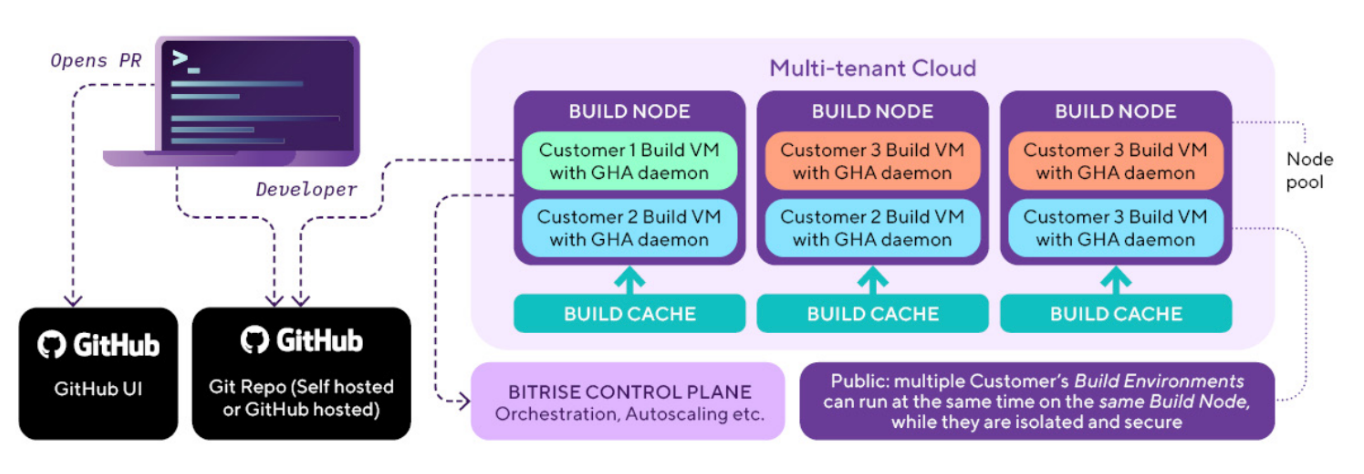
Dedicated runners. Exclusive hardware reserved for your organization, with dedicated IP ranges for firewall allowlisting and network policy compliance
Private runners. Fully isolated VPC with private firewall, designed for regulated industries with strict data sovereignty and audit requirements
"Building infrastructure like this can seem straightforward at first, it certainly did for us, but maintaining it and scaling it is where the real cost shows up. And unless that's your core competency, it's very hard to justify to your company that we're now going to be a data center." Nathan Hillyer, Director of Engineering at ForeFlight
One line of YAML:
runs-on: bitrise-m4-pro
Get started for free
Get a 30-day free trial and join the 400,000+ mobile developers who already love Bitrise.
Start free trial